The Red Aksaray Mosque—the Seljuk’s Crooked Minaret in the Heart of Central Anatolia
The Red Aksaray Mosque is one of those rare monuments in Turkey that surprises not with its grandeur or luxury, but with its own rebellious character. In the center of the small Anatolian town of Aksaray, amidst the familiar minarets, a brick tower rises, noticeably tilted from the vertical—for this, it has been nicknamed Eğri Minare, “The Crooked Minaret.” The Red Aksaray Mosque got its name from the warm hue of the red brick used to build its minaret, and the complex itself preserves the memory of the heyday of the Seljuk Sultanate of Rum. Here, amid the bustling market streets and tea houses, travelers encounter not a tourist attraction, but a living part of city life—a witness to eight centuries that still calls the faithful to prayer today.
History and Origin of the Red Aksaray Mosque
The minaret, which has become the monument’s symbol, dates back to the era of the Anatolian Seljuks and was built between 1221 and 1237—that is, during the reign of Sultan Alaeddin Keykubad I. This was a time when the Seljuk Sultanate of Rûm was at its peak: trade along the caravan routes flourished, grand caravanserais, madrasas, and mosques were being built, and a distinctive aesthetic of brick, stone, and glazed tiles was emerging in Anatolian cities. The Red Aksaray Mosque was born precisely in this atmosphere, when Aksaray served as a vital hub between Konya—the sultanate’s capital—and Cappadocia.
The city of Aksaray itself bore a name similar to its current one during that era and was surrounded by walls. Merchant caravans passed through it, theologians studied in the madrasas, and rulers built mosques to emphasize their piety. The construction of the red-brick minaret became a kind of visual landmark for the city: a traveler approaching from Konya or Kayseri could spot its reddish shaft from afar against the backdrop of the clay-colored streets. According to Turkish sources, the minaret was conceived as a tall, inviting beacon—an image that Seljuk architects sought to achieve on more than one occasion.
The mosque that stands next to the minaret today appeared much later. Contrary to first impressions, the minaret and the mosque are not part of a single 13th-century project: sources explicitly state that the adjacent mosque building was constructed later, while the minaret itself is an authentic monument of the Seljuk era. Thus, the visual complex that tourists see today is a layering of eras: an ancient brick pillar and a later prayer hall, connected by a shared courtyard and a shared destiny.
By the 20th century, the minaret, which had stood for hundreds of years on the soft soil of the Anatolian city, had begun to lean noticeably from the vertical. The tilt gave rise to a popular nickname—the “Crooked Minaret,” Eğri Minare—by which the monument is far better known to locals than by its official name. By 1973, the threat of collapse had become so real that engineers took emergency measures: the minaret was secured with steel cables to halt further tilting and preserve the structure. This operation saved the tower, and it continues to stand, serving as a reminder of both the Seljuk heritage and the fragility of any man-made wonder.
Architecture and What to See
From a distance, the Red Aksaray Mosque looks deceptively modest: a brick tower, a small building next to it, a quiet courtyard. But the closer you get, the more clearly the details characteristic of the Seljuk style emerge, making the monument truly valuable for those who love the architecture of the early Islamic period in Anatolia.
Minaret: red brick and precise calculations
The minaret rests on a square stone base that transitions into a slender cylindrical shaft. This transition from a square pedestal to a round body is a classic solution employed by Seljuk craftsmen: it ensures stability while simultaneously creating a recognizable silhouette. The entire shaft is made of red fired brick, and it is precisely because of its color that the monument received its second name—Kızıl Minare, “Red Minaret.” In the rays of the evening sun, the tower literally glows with a rusty-copper hue, and it becomes clear why 19th-century travelers compared it to coal taken from a furnace.
The cylindrical shaft is divided into two parts by a thin, profiled band—a silme. The lower section is decorated with a characteristic zigzag pattern created by bricks laid in a special way: this technique is familiar from Seljuk monuments in Konya and Sivas. The upper tier is decorated with blue-green glazed mosaic—chini mosaic—that shimmering turquoise tile that has become the hallmark of all Seljuk architecture in Anatolia. When the sun hits at just the right angle, the colored mosaic flares with patches of deep turquoise against the backdrop of warm brick, and the entire minaret transforms into a vivid contrast of fire and water.
The Leaning Minaret and Steel Cables
The main feature that draws many visitors is, of course, the noticeable tilt. The lean is clearly visible to the naked eye: the shaft leans to one side, reminiscent of its famous “sister” in Pisa, and it is precisely this deviation that gave rise to the local name Eğri Minare. Steel cables, installed in 1973, wrap around the upper part of the minaret and secure it, preventing it from falling. For architectural purists, this is a drastic intervention, but it is precisely thanks to it that the 13th-century tower has survived to this day.
The adjacent mosque and the urban context
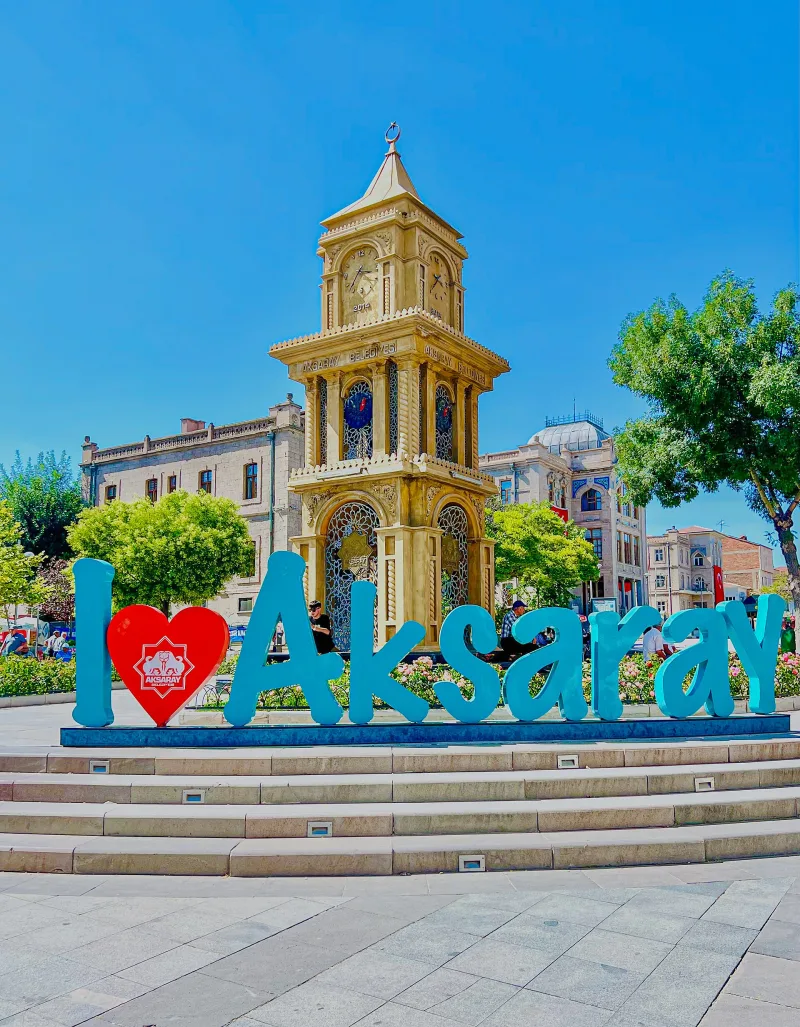
The neighboring mosque, built later, is designed in a more restrained style: a modest prayer hall, a quiet courtyard, and a few steps leading to the entrance. It remains active to this day, and the muezzin regularly ascends to call the faithful to prayer—the sound of the azan, echoing off the walls of the old city, transforms a visit to the monument into a small Anatolian spectacle. All around is the typical fabric of Aksaray: a bazaar, a street lined with awnings, a clock tower, cafes serving Turkish tea in tulip-shaped glasses—all within walking distance.
Seljuk Style and Its Place in Architectural History
To truly appreciate the monument, it helps to mentally place it alongside other Seljuk minarets in Anatolia from the same era. Thirteenth-century masters loved to play with color and texture: red brick alternating with stone masonry, turquoise glaze, geometric zigzags, stalactite cornices—all these are their recognizable techniques. In the Aksaray Minaret, these elements are brought together in a condensed, almost schematic form. Here there is none of the lavish decoration found in the large Konya madrasas, but the very essence of the style is present: rhythmic brickwork, a silme band, çini mosaics, and a slender cylindrical form. For travelers planning a grand tour of Seljuk heritage—Konya, Sivas, Erzurum—the Red Aksaray Mosque serves as an excellent “introduction” to this aesthetic: here, you can examine it up close, without crowds and without an admission fee.
Interesting Facts and Legends
- Locals don’t refer to the monument by its official name, but rather as Eğri Minare—“Crooked Minaret.” So it’s easier to tell a taxi driver in Aksaray exactly that: any mention of Eğri Minare will immediately take you to your destination without further explanation.
- According to urban legend, the minaret leaned over out of sadness: when it heard that a similar tower had been built in Pisa, it supposedly leaned over to “look at its rival.” This humorous explanation has been circulating in Aksaray since the 20th century and is often repeated by local guides.
- The red color of the shaft is neither paint nor a coating: it is the natural hue of fired brick, characteristic of 13th-century Seljuk architecture. This is precisely why, unlike many restored monuments, the minaret retains its authentic historical appearance.
- The steel cables installed in 1973 were originally intended as a temporary measure but have become a permanent part of the skyline. Today they are seen as a “scar of the era,” a reminder that monuments survive thanks to human intervention.
- The minaret and the mosque were not built at the same time: the authentic Seljuk monument is the minaret itself, dating from 1221–1237, while the adjacent mosque building appeared later. This “composite” age of the complex is characteristic of many old Anatolian cities, where monuments have been expanded with new sections over the centuries.
How to Get There
Aksaray is located in Central Anatolia, at a convenient point between Cappadocia, Konya, and Lake Tuz. The city does not have its own major airport, so travelers usually fly into Nevşehir (NAV) or Kayseri (ASR)—both about a 1.5–2-hour drive away. Another option is to fly into Ankara (ESB) and travel south from there: the drive takes about 3 hours on the highway.
The most convenient option is to take an intercity bus: the Turkish otobüs network provides excellent connections between Aksaray and Konya, Ankara, Kayseri, and Nevşehir. The Aksaray Otogar bus station is located on the outskirts of the city, and from there, you can take a city dolmuş or a taxi to the center; the trip takes 10–15 minutes. There are no trains to Aksaray itself, so the train is only an option with a transfer via Konya.
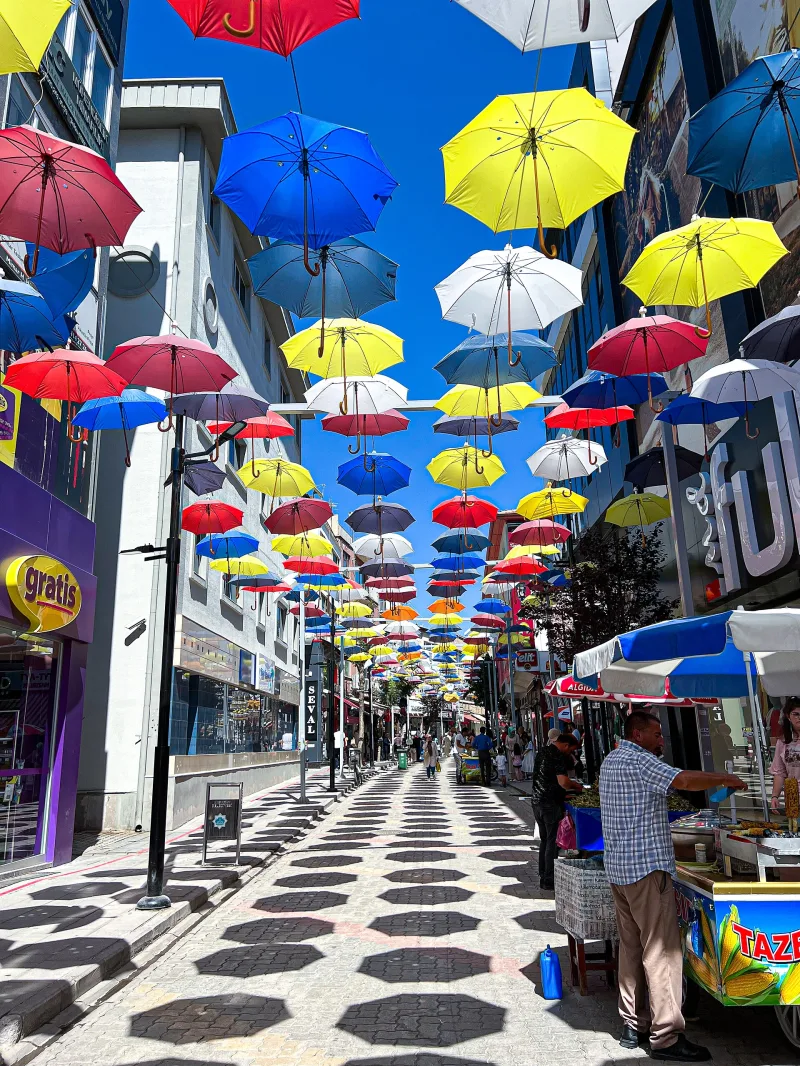
Within the city, the easiest way to reach the monument is on foot: the Red Aksaray Mosque stands right in the center, next to the main square, the clock tower, and the famous Umbrella Street. If you’re staying at a hotel in the old town, the walk to the minaret will take no more than 10–15 minutes. Any taxi will take you there in a couple of minutes to the address Eğri Minare.
Tips for travelers
The best time to visit is spring (April–May) and fall (September–October), when Central Anatolia is free from the summer heat and winter winds from the plateau. In the summer, daytime temperatures can rise above 30°C, and there is little shade near the minaret, so it’s best to plan your visit for the morning or just before sunset—you’ll also get the most beautiful photos: at sunset, the red brick literally glows. In winter, Aksaray is windy and cool, and snow is possible—but the minaret looks especially photogenic with its white “cap.”
The mosque is active, so the standard dress code applies: women are advised to cover their heads with a scarf and cover their shoulders and knees; men should not enter in shorts. During the five daily prayers, tourists are advised to wait outside—the call to prayer can be heard perfectly well at the foot of the minaret and becomes part of the experience in itself. Admission to the grounds is free; no special tickets are required.
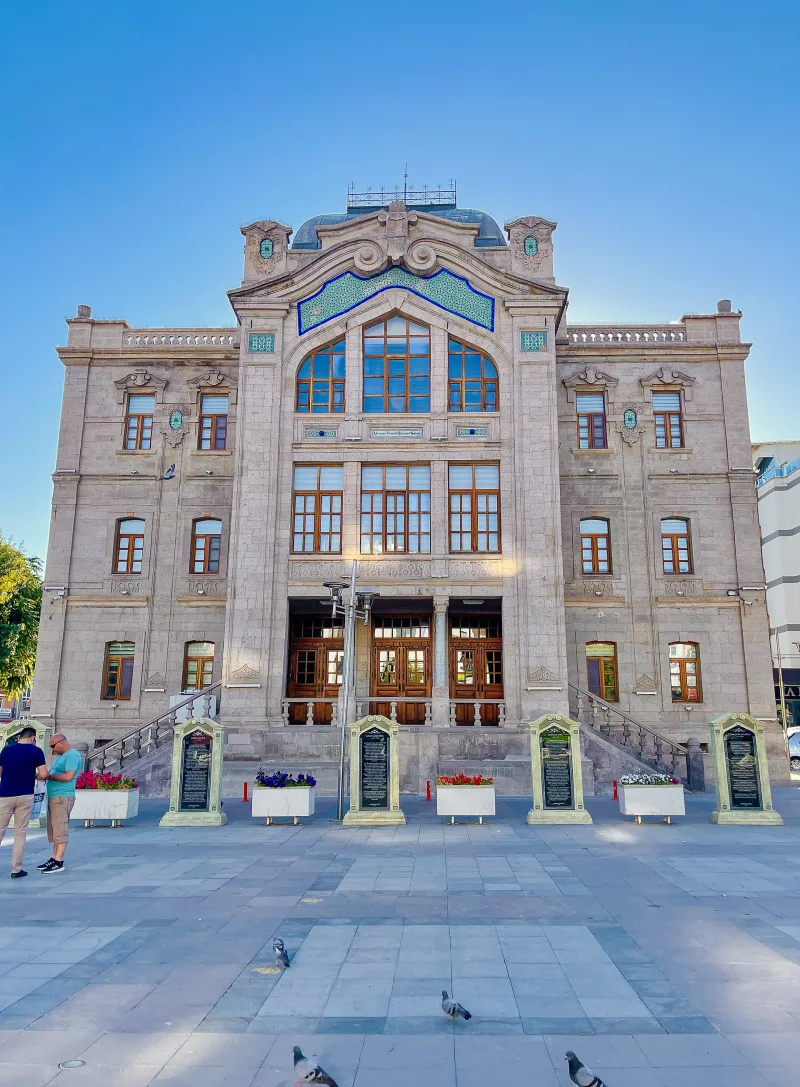
Allow 30–40 minutes to explore the monument itself: walk around the minaret, examine the zigzag pattern and turquoise mosaic up close, enter the mosque courtyard, and take a few photos from different angles. This is enough to soak up the atmosphere. From there, it makes sense to combine your visit into a single city tour: the clock tower, Umbrella Street, the city bazaar, and the Aksaray Museum. In half a day, you can easily cover the historic center and still have time for tea with local pekmez at one of the teahouses.
Aksaray is very convenient as a stopover on a larger route through Central Anatolia: many travelers stop here between Cappadocia and Konya or on the way to Tuz Lake and the Sultanhan caravanserai, located a half-hour’s drive away. If you’re traveling from the west, it makes sense to combine your visit with a tour of Sultanhan—the largest Seljuk caravanserai in Anatolia, ideologically and stylistically akin to your minaret. The Red Aksaray Mosque does not impress with its scale, like Hagia Sophia or the Blue Mosque, but that is precisely its charm: it is an authentic, unpretentious 13th-century monument that exists not for the sake of tourists, but for the sake of its city—and that makes an encounter with it all the more valuable for the attentive traveler.